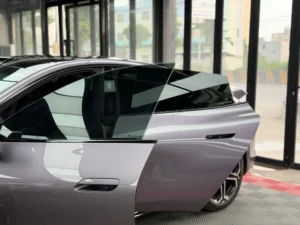
When we discuss the “futuristic” nature of cars, autonomous driving, new energy vehicles, or smart cockpits often come to mind first. However, few people focus on “protection technology,” the hidden cornerstone that underpins a vehicle’s long-term value. In today’s rapidly evolving automotive industry, a vehicle’s lifecycle is no longer limited to 5-8 years. Whether it’s the extended battery degradation cycle of new energy vehicles or the rising collectible value of classic models, we need to re-evaluate the definition of “car protection”—it’s no longer simply washing and waxing the car, but a systematic approach built around “asset preservation,” “technical adaptation,” and “experience upgrades.” Within this approach, paint protection film (PPF) is becoming a core component, particularly TPU-based products, which are redefining the standard for car protection.
- Why must modern cars upgrade their “protection systems”? Three major contradictions are driving the demand for advanced protection.
If you still believe that “a car is just a means of transportation, and scratches can be fixed with a touch-up,” you may need to first understand the three core contradictions between current car usage scenarios and the vehicle’s inherent characteristics—contradictions that have long rendered traditional protection methods ineffective. 1. Changing Vehicle Value Structure: Paint Becomes a “Non-Renewable Asset”
In the era of traditional fuel-powered vehicles, paint was primarily a decorative feature, and repainting techniques were mature and inexpensive. However, the paint process for new energy vehicles is undergoing a revolutionary change. To accommodate lightweight bodies (such as aluminum hoods and carbon fiber components), automakers generally employ a multi-layer, low-temperature baking process, such as Tesla’s “nano-ceramic paint” and BMW’s “customizable matte paint.” These paints are applied by the manufacturer in a dust-free, temperature-controlled workshop with a constant humidity and temperature, relying on robots to precisely control the coating thickness (typically within a tolerance of less than 5 microns). Once the paint is damaged, repainting at a 4S dealership will fail to recreate the original finish. Not only may color change occur, but the high-temperature baking process can also damage the vehicle’s base material (e.g., aluminum oxidation and carbon fiber aging). Data shows that if the original paint of a 300,000 yuan new energy vehicle suffers damage exceeding 0.5 square meters, the residual value of the vehicle will drop by 8%-12% after repainting, equivalent to an additional 20,000 yuan in asset value per year. 2. Deteriorating Usage Scenario: From “Urban Commuting” to “All-Scenario Erosion”
Modern car owners’ car usage scenarios have long transcended the confines of “home and work.” Weekend drives on unpaved roads can cause gravel to strike the bottom edge of the car door at speeds of 80 km/h. Parking under a tree can cause the acidic substances in bird droppings (pH 2.5-4.0) to penetrate the clearcoat within two hours. Even when refueling at a highway service area, splashing oil and ultraviolet light can cause irreversible “yellow oxidation” on the paint surface. A more subtle threat comes from automatic car washes: fine sand particles left on traditional brushes can cause “sunburst” scratches on the paint surface under the pressure of high-pressure water. While these scratches are barely visible to the naked eye, they can reduce the paint’s gloss by 15% annually, making the vehicle’s appearance noticeably “worn” after three years. According to data from an automotive aftermarket research organization, the percentage of car owners who will replace their vehicles prematurely due to “non-accidental paint damage” in 2024 will increase by 23% compared to 2019. The core reason is that traditional protection methods such as waxing and glazing are no longer able to withstand the erosion of complex driving environments.
- Technical Iteration Requirements: Protection Solutions Must Adapt to the Characteristics of “Smart Cars”
New energy vehicles, especially smart driving models, place far greater demands on the “functionality” of their paint surfaces than traditional vehicles. For example, some models use “translucent paint” for the roof lidar cover and door handle sensing area. Scratches can directly affect the lidar’s detection accuracy (the error can increase from ±5cm to ±20cm) and even trigger a “safety degradation” of the smart driving system. Furthermore, new energy vehicles often have their body circuits located on the inside of door panels and fenders. If paint damage allows rainwater to penetrate, it can cause a short circuit, resulting in repair costs of tens of thousands of yuan. This means that modern car protection solutions must not only protect the paint but also its functionality—a requirement that traditional protection methods clearly cannot meet. - Paint Protection Film: The “Third-Generation Solution” for Automotive Protection
In response to the aforementioned contradictions, the automotive aftermarket has gradually evolved into three generations of protection technologies: the first generation is “physical covering” (waxing, glazing), which relies on manual application, has a short protection period (1-3 months), and cannot withstand physical impact; the second generation is “chemical bonding” (crystal coating, coating), which bonds to the paint surface through silicon-oxygen bonds. Although it can increase hardness, it cannot self-repair once scratches appear. Moreover, improper application (such as uneven thickness of the crystal coating) can accelerate paint aging; the third generation is the “physical isolation + intelligent repair” paint protection film. By covering the paint surface with a highly tough film, it achieves the dual functions of “active defense” and “self-healing”, becoming the only solution that can simultaneously address “asset preservation”, “scenario adaptation”, and “functional protection”. The core value of paint protection film lies in its ability to create a removable, repairable physical barrier: it provides 100% protection against corrosive substances like bird droppings, oil, and UV rays, protecting the paint from direct contact with sources of damage. Furthermore, the film absorbs impacts from stone chips and minor scrapes, rather than inflicting damage to the paint. Crucially, high-quality paint protection film also boasts a “thermal repair” function. Even small scratches can be repaired with a heat gun (60-80°C), which automatically reshapes the film’s molecular structure and eliminates the need for frequent replacement or polishing. Test data shows that vehicles fitted with qualified paint protection film maintain over 95% of their original gloss over a three-year lifespan, and their residual value is 15-20% higher than vehicles without the film, effectively providing a form of “asset insurance.”

- Why is TPU the “only choice” for paint protection films? Examining the essential differences based on substrate properties
In the paint protection film market, three common substrates are available: PVC (polyvinyl chloride), TPH (modified PVC), and TPU (thermoplastic polyurethane). However, from a professional perspective, TPU is the only substrate that meets the requirements for “long-term protection,” while the other two materials are essentially “transitional products.” The differences between the three can be clearly distinguished by the following core dimensions: - Toughness and Impact Resistance: TPU is a “stretchable shield”
The greatest threat to cars while driving is high-speed physical impact (such as gravel and branches), which requires protective films to possess extremely high toughness and tear resistance. TPU has an elongation at break of 500%-700%, meaning it absorbs energy by stretching rather than breaking directly upon impact. PVC, on the other hand, has an elongation at break of only 100%-150%, and will crack or even fall off if subjected to an impact force exceeding 5N. More intuitive test data shows that when a 5mm diameter steel ball is dropped from a height of 1.5 meters onto three protective films (all 8 mil thick), the PVC film develops a 3mm diameter hole, the TPH film develops a noticeable dent, and the TPU film only briefly deforms, fully recovering after 10 seconds without leaving any mark. This is the core reason why TPU films are so effective in resisting high-speed gravel impacts. - Weather Resistance and Stability: TPU Can Withstand “Extreme Environmental Tests”
As assets used outdoors, automobiles are subject to extreme environments such as high and low temperatures, UV rays, and humidity fluctuations. PVC releases plasticizers at high temperatures (above 60°C), causing the film surface to become sticky and yellow, and even adhere to the paint. Later, when the film is removed, adhesive residue remains, damaging the original paint finish. Although TPH material has been improved, it becomes brittle and prone to cracking at temperatures below -20°C. TPU, by adding UV inhibitors and antioxidants, remains stable in temperatures ranging from -40°C to 80°C, with a UV transmittance of less than 0.1%—equivalent to providing a layer of SPF 1000 sun protection for paint. According to accelerated aging tests conducted by a third-party testing agency, after simulating five years of outdoor use, the yellowing index (Δb) of TPU film was only 0.8 (the industry standard is ≤1.5), while the yellowing index of PVC film reached 3.2, completely losing its protective function. - Repairability and Convenience: TPU’s “thermal repair” is cost-free.
As mentioned earlier, modern car owners place high demands on the convenience of their protective solutions, and the self-healing function of TPU film precisely addresses this pain point. TPU film’s surface coating uses a thermoplastic resin. When small scratches (≤0.5mm wide) appear, simply by exposing it to sunlight (at temperatures above 40°C) or heating it with a heat gun, the coating molecules will reflow and fill the scratch, eliminating the need for polishing or replacement. This feature not only reduces ongoing maintenance costs (traditional crystal coating repairs cost 800-1500 yuan per session), but also prevents wear and tear on the paint caused by frequent polishing (each polishing process removes 5-10 microns of clearcoat. The factory clearcoat is typically only 30-50 microns thick, and over-polishing can expose the paint underneath). PVC and TPH films, on the other hand, have no repair function. Once scratches occur, they must be completely replaced, which is not only costly (replacing the entire vehicle film costs 3000-5000 yuan) but also risks damaging the paint. 4. Environmental Protection and Compatibility: TPU Meets the Future Needs of “Smart Cars”
With tightening environmental regulations, PVC has been restricted by the EU RoHS Directive due to the release of toxic substances (such as hydrogen chloride) during production and disposal. TPU, however, is an environmentally friendly polymer material with a recyclability rate of over 90%. It also leaves no adhesive residue when removed (high-quality TPU films use a “low initial tack pressure-sensitive adhesive” that maintains bond strength over time and does not damage the paint finish when removed). More importantly, TPU films boast a light transmittance exceeding 92%, effectively eliminating LiDAR and millimeter-wave radar signal penetration and perfectly meeting the functional requirements of smart driving vehicles. This is something that PVC and TPU films cannot achieve (their light transmittances are typically below 80%, which can attenuate radar signals). Conclusion: The future of automotive protection hinges on the principle of “prevention is better than repair.”
As cars evolve from mere transportation to intelligent mobile spaces, their protection must shift from post-repair to pre-emptive prevention. Paint protection films, especially those made of TPU, not only address core issues facing modern cars, such as paint damage, asset depreciation, and functional compatibility, but also redefine the value of automotive protection—it’s no longer simply about cosmetic maintenance but an investment in the long-term value of the vehicle.
Choosing TPU paint protection film is essentially choosing a kind of “certainty”: assurance that the paint won’t degrade due to daily use, that the vehicle’s residual value won’t decrease due to non-accident damage, and that intelligent driving features won’t be affected by the protection solution. In a future characterized by rapid technological advancements, protective technologies may become even more intelligent (such as self-cleaning and temperature-regulating smart films), but TPU, with its superior physical properties, will remain the cornerstone of automotive protection. For car owners, the best protection is always to prevent damage from ever occurring.