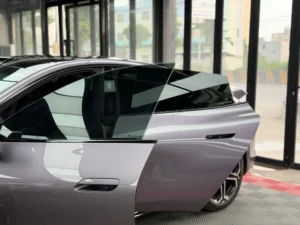
Your brand-new car is only two weeks old, and yet small gravel chips have already left scratches. A few days outdoors, and bird droppings or tree sap have etched visible marks into the paint. For many owners, these are painful moments.
Paint Protection Film (PPF)—often called a “car armor”—has become a must-have for preserving original factory paint. But with so many materials and products on the market, how do you avoid wasting money on the wrong film?
This guide focuses on why TPU is the best choice, and gives you a step-by-step installation process, tool checklist, and care tips—so your investment delivers lasting value.
1. Car PPF Materials: Why TPU is the “Optimal Solution”
Today’s PPF market mainly offers three materials—PVC, TPH, and TPU—with performance differences that are worlds apart. Here’s a quick comparison:
| Material | Composition | Protection | Anti-Yellowing | Scratch Self-Healing | Lifespan | Environmental Safety |
|---|---|---|---|---|---|---|
| PVC | Polyvinyl Chloride | Low (brittle) | Poor (1–2 yrs) | None | 1–2 yrs | Poor (plasticizers) |
| TPH | PVC with additives | Medium | Limited (2–3 yrs) | Weak (only coating-level) | 2–3 yrs | Average |
| TPU | Thermoplastic Polyurethane | High (impact & puncture resistant) | Excellent (5–10 yrs) | Yes (base + coating dual healing) | 5–10 yrs | Eco-friendly, recyclable |
👉 TPU is the only material that balances protection, durability, and practicality. Let’s break down its core strengths.
(1) Protection Power: Impact Resistance + Corrosion Shield
- Elastic strength: TPU stretches over 500%, absorbing gravel impact without denting the paint.
- Corrosion resistance: The topcoat resists bird droppings, sap, acid rain, and alkaline cleaners. Bird droppings (uric acid pH 1.5–2.5) can corrode bare paint in 24 hrs; TPU isolates and prevents permanent damage.
(2) Durability: Anti-Yellowing + All-Climate Adaptability
- UV stabilizers block harmful rays, preventing yellowing. Third-party tests show premium TPU films keep Δb < 1.5 after 5 years of sun exposure—almost invisible to the eye.
- Works from -40°C to 80°C without cracking or warping, covering both winter and summer extremes.
- Service life: 5–10 years, far beyond PVC/TPH.
(3) Practicality: Scratch Self-Healing + Gloss Boost
- Dual self-healing system: Both TPU base and topcoat recover fine scratches at room temp or mild heating (~60°C).
- High transparency (≥90%) enhances car paint gloss by 10–20%, like a permanent wax finish.
⚠️ Avoid “fake TPU” traps: Many low-cost films (PVC blends, TPH) are sold as TPU. Signs of authentic TPU:
- Warranty ≥ 5 years with official electronic registration
- Scratch recovery when heated
- Stretchability 1.5× without tearing
2. How to Install TPU PPF: 6-Step Professional Process
Step 1: Preparation
- Environment: Dust-free workshop, 20–25°C temp, 50–60% humidity.
- Vehicle cleaning:
- Pre-wash with 0.8–1.2MPa pressure washer
- Hand wash with neutral pH shampoo
- Degrease with non-abrasive cleaner to remove wax/oil
Step 2: Paint Correction
Even new cars may have swirl marks. Use fine polish (<3μm cutting power) with wool/sponge pads. Avoid excessive polishing (OEM paint is only 80–120μm thick).
Step 3: Film Cutting & Positioning
- Pre-cut kits: Computer-cut to match car models, safer for luxury cars.
- Hand-cut: Allows “edge wrapping” but requires skilled technicians. Always use masking tape to protect paint during cutting.
Step 4: Application (Wet Method)
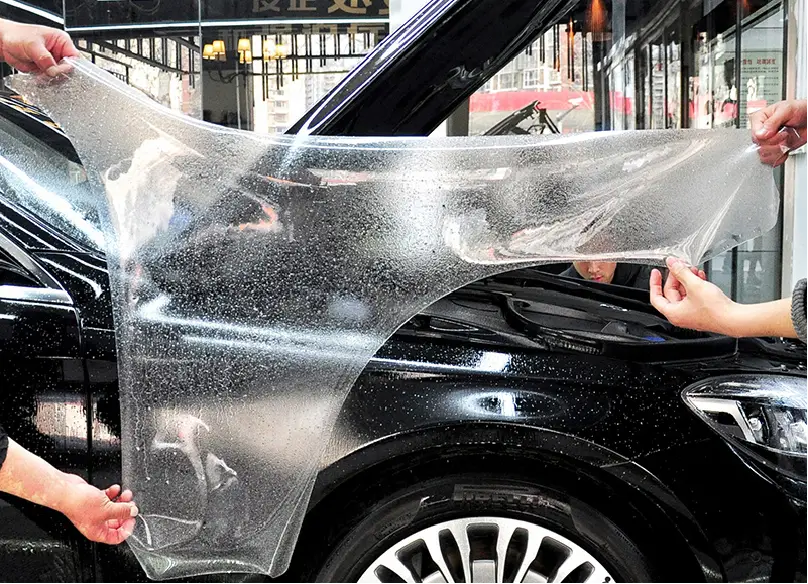
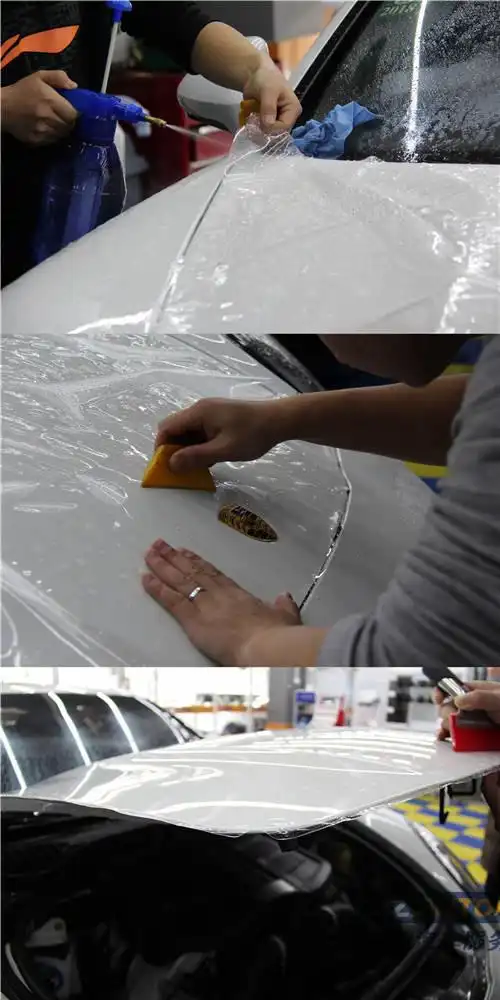
- Spray installation solution (distilled water + neutral surfactant) on paint and adhesive side
- .

- Place film, adjust, and squeegee from center outward to remove water.

- For curves, heat gently (60–80°C) with a heat gun and shape.
- Ensure no “water haze” or trapped moisture.
Step 5: Edge Wrapping
- Heat edges to 50–60°C for flexibility.
- Use hard squeegee to tuck into panel gaps (doors, hood).
- Press edges with microfiber for 30s to secure adhesion.
Step 6: Final Inspection & Curing
- Check under LED lights for bubbles, edges, or defects.
- Cure in workshop for 24 hrs before washing or lowering windows.
3. Essential Tools + 3 Key Tips
🔧 Tools You’ll See in a Pro Shop
- High-pressure washer, polishers, degreaser, microfiber cloths
- Soft & hard squeegees, heat gun, precision cutter, CNC plotter
- Dust-free room, inspection lights, low-tack tape
⚠️ 3 Golden Rules
- Before installation:
- Choose branded TPU (e.g., XPEL, Llumar, SunTek) with 5+ year warranty.
- Verify official electronic warranty and installer credentials.
- During installation:
- Monitor polishing (paint removal ≤5μm).
- Watch cutting—ensure masking tape is used.
- Confirm proper edge wrapping.
- After installation:
- No car wash for 7 days; then only low-pressure rinsing.
- Quarterly maintenance with dedicated PPF care sprays (no wax/sealant).
- Small scratches can be heat-repaired; large bubbles require pro service.
4. Conclusion: TPU PPF = Long-Term Protection for OEM Paint
Your factory paint is a one-time asset—once damaged, even repainting cannot match OEM hardness and corrosion resistance.
Investing in premium TPU PPF:
- Preserves paint in “like-new” condition
- Protects resale value (adds 5–10% to car’s secondhand price)
- Reduces repair/maintenance costs
Formula for success:
👉 Branded TPU Film + Certified Installation + Proper Aftercare = Guaranteed OEM Paint Protection
With the right film and professional application, your car will shine like new for years—and your investment pays off in both pride and resale value.